SUMMER LIMITED EDITION VAPES NOW AVAILABLE

What Are Children Learning Flash Cards?
A Children Learning Flash Card is a small learning card with a picture, word, number, shape, or simple question. Parents and teachers use these cards to introduce information through brief, repeated practice. A red apple, the word “apple,” and its sound may appear on one card. This clear pairing helps children connect images, language, and meaning.
Early childhood education expert Maria Montessori wrote, “The goal of early childhood education should be to activate the child’s own natural desire to learn.” Her principle supports purposeful flash card use. Cards should invite attention, not replace conversation, play, or real experiences. A child can see a picture of a triangle, then find one on the kitchen floor. That moment makes the lesson more memorable.
They are not magic.
In my experience, children respond better when adults follow their interests. A two-minute session may work better than a forced twenty-minute drill. Use a warm voice, pause often, and let the child answer imperfectly. Mistakes can show what needs more practice. However, flash cards can become dull when adults rush through them or demand perfect recall. This limitation deserves attention.
Well-designed Children Learning Flash Card sets use readable fonts, uncluttered images, accurate information, and age-appropriate vocabulary. Experts also recommend mixing card practice with storytelling, movement, drawing, and everyday discovery. The best results come from consistent interaction, not excessive repetition. Used thoughtfully, flash cards can support early vocabulary, memory, recognition, and confidence while leaving room for curiosity.
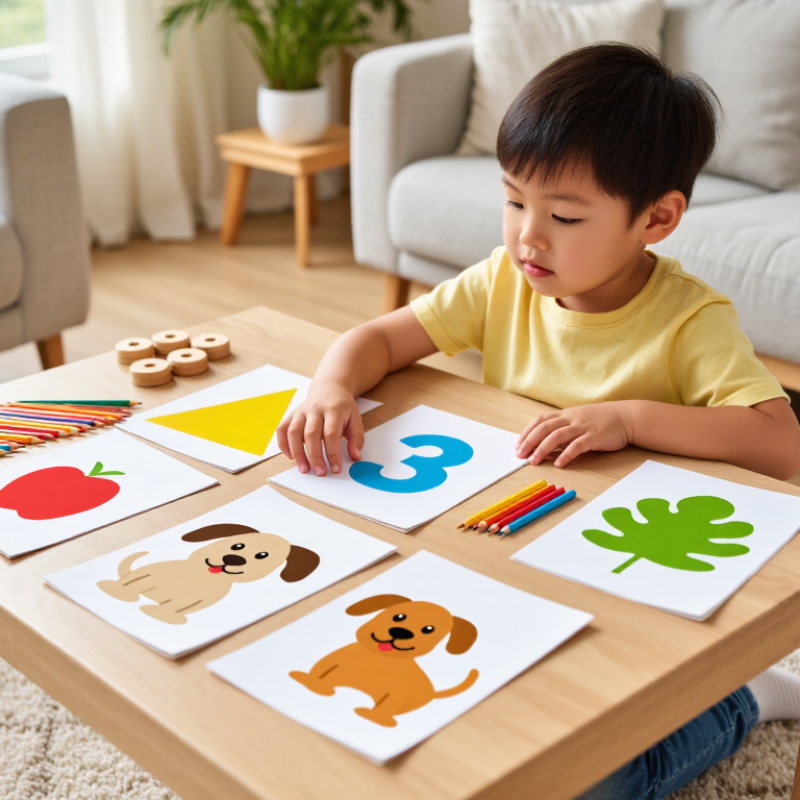
Children’s learning flash cards are compact visual tools designed to present one idea at a time. Each card usually combines a picture, word, number, letter, or simple question. For example, a card may show a red apple on the front and the word “apple” on the back. Their main purpose is to strengthen recognition, vocabulary, memory, and early academic skills through brief, repeated practice. They work best when children handle the cards, say answers aloud, and connect images with real experiences. A child can match animal cards with toy figures or sort number cards beside five wooden blocks. These activities make learning more concrete. They also allow adults to notice pronunciation, confusion, and growing confidence.
Flash cards should support interaction, not replace it. An adult might ask, “What do you notice?” or “Where have you seen this?” Such questions encourage language and reasoning beyond memorization. Evidence-informed teaching often uses retrieval practice, but speed should not become the only measure of progress. They are not magic. I have seen children recite card answers while misunderstanding the underlying idea. That limitation matters. A picture of a triangle cannot replace building one with craft sticks. Some children learn better through movement, touch, stories, or conversation. Caregivers and educators should vary the activity, reduce pressure, and repeat difficult cards gently. Even careful adults can mistake quick responses for deep understanding.

What Are Children Learning Flash Cards?
Common Types of Flash Cards for Children
Children’s learning flash cards usually support short, focused practice. Common sets include alphabet cards, phonics cards, sight-word cards, number cards, and basic addition cards. Picture cards often teach colors, shapes, animals, body parts, and everyday objects. Bilingual cards can connect a familiar word with a new language. Each card should show one clear idea, such as a red circle or the word “sun.”
Flash cards work best through retrieval practice, not passive looking. A 2013 review in Psychological Science in the Public Interest rated practice testing and spaced practice among the most effective learning techniques. The National Reading Panel also reviewed 38 phonics studies and found benefits from systematic, explicit instruction. Flash cards can support that structure, but they cannot replace conversation, reading, play, or teacher guidance. They are useful tools, not complete lessons. I have seen children memorize answers while still misunderstanding them.
Tips: Show five to ten cards at a time. Ask the child to explain, point, sort, or use each word in a sentence. Mix easy and difficult cards. Repeat missed cards later, rather than correcting every mistake immediately. Keep sessions brief, perhaps five minutes. Watch the child’s face. Boredom is data. Some cards may be too easy, too crowded, or poorly matched to the child’s language level. Adjust them. The most attractive card is not always the most helpful one.
| Flash Card Type | Common Age Range | Primary Learning Focus | Typical Card Content | Skills Supported | Practical Use Example |
|---|---|---|---|---|---|
| Alphabet and Letter Cards | 2–6 years | Letter recognition and early phonics | A printed uppercase or lowercase letter, often paired with a familiar object or picture | Visual discrimination, letter naming, phonological awareness, and early reading readiness | Ask the child to name the letter, identify its sound, and find another object beginning with that sound. |
| Phonics and Word Cards | 4–7 years | Sound–letter relationships and word decoding | Single sounds, blends, word families, or short words such as “cat,” “ship,” or “play” | Sound blending, segmenting, decoding, spelling, and vocabulary development | Show a word and have the child say each sound before blending the sounds together. |
| Numbers and Counting Cards | 2–6 years | Number recognition and counting | A numeral displayed with a matching quantity of dots, objects, or pictures | One-to-one correspondence, counting sequence, quantity comparison, and number sense | Invite the child to count the pictured objects and match the quantity to the numeral. |
| Math Facts Cards | 5–10 years | Arithmetic fact fluency | A calculation on the front and the answer on the back, covering addition, subtraction, multiplication, or division | Recall speed, calculation accuracy, mental math, and confidence with basic operations | Present one problem at a time and encourage the child to explain the strategy used to solve it. |
| Shapes and Colors Cards | 2–5 years | Visual classification and descriptive language | Basic shapes, color samples, or objects that demonstrate a particular shape or color | Observation, sorting, comparison, fine-motor matching, and early geometry vocabulary | Ask the child to name the shape or color and locate another item with the same feature. |
| Animals and Nature Cards | 2–7 years | Vocabulary and general knowledge | Animal or plant images with names and, for older children, simple facts about habitats or characteristics | Word learning, categorization, memory, oral language, and knowledge of the natural world | Ask the child to name the animal, describe it, and group it by habitat or body features. |
| Everyday Objects Cards | 2–5 years | Receptive and expressive vocabulary | Pictures of familiar items such as clothing, food, furniture, tools, or vehicles | Object identification, word retrieval, categorization, and sentence formation | Have the child name the object, describe its use, and place it in a related category. |
| Emotions and Social Skills Cards | 3–8 years | Emotional vocabulary and social understanding | Facial expressions, emotion words, social situations, or short behavior scenarios | Emotion recognition, perspective-taking, self-expression, and problem-solving | Ask the child how a character may feel and suggest a safe, respectful response to the situation. |
| Daily Routine and Safety Cards | 3–8 years | Sequencing and practical life skills | Steps for routines such as handwashing, getting dressed, crossing a street, or preparing for school | Sequencing, independence, listening comprehension, and safety awareness | Ask the child to arrange the cards in the correct order and explain why each step matters. |
| Foreign-Language Vocabulary Cards | 4 years and up | Second-language vocabulary and pronunciation | A picture with a word in the target language, sometimes paired with a translation or pronunciation guide | Word recall, listening discrimination, pronunciation practice, and basic communication | Show the picture, encourage the child to say the target word, and use it in a simple phrase. |
What Are Children Learning Flash Cards?
How Flash Cards Support Early Learning
Children’s flash cards can support early learning when adults turn them into conversations, not speed tests. A picture of an apple may invite naming, counting, describing, and comparing. These small exchanges build vocabulary and listening skills. The Education Endowment Foundation’s Teaching and Learning Toolkit reports that oral-language approaches can support about six additional months of progress, on average. Flash cards cannot create that progress alone. The adult’s questions matter more than the card’s design.
The National Early Literacy Panel reviewed 52 studies and identified alphabet knowledge and phonological awareness as strong predictors of later reading success. Cards showing letters, sounds, or simple rhymes can provide short, repeated practice. Keep sessions brief. Ask, “What sound starts sun?” Then pause. A child may answer incorrectly, and that is useful information. Gentle correction works better than pressure. Some children also learn through movement, songs, or real objects, so cards should not become the only method. I have seen children remember a picture quickly but struggle to use the word in a sentence. That gap deserves attention. Flash cards support early learning best when they connect printed symbols with speaking, touching, sorting, and everyday experiences. Small steps count.
Flash cards can support early learning by giving children repeated, playful practice with vocabulary, colors, letters, numbers, and story concepts. The chart shows selected CDC developmental milestones and the age by which many children are expected to demonstrate them.
How to use flash cards effectively: Keep sessions brief, say the word aloud, ask questions, and connect each card to real objects, books, songs, and conversations. Flash cards are a practice tool and do not replace interactive play or reading.
Developmental milestone references: Centers for Disease Control and Prevention milestone checklists.
Flash card activities can help children build early language, memory, and attention skills. In my experience, children often enjoy naming a picture before they can explain it. A card showing an apple may encourage them to say “red,” “round,” or “sweet.” These small responses support vocabulary and descriptive language. Cards with numbers can strengthen counting, number recognition, and simple comparison. A child might sort cards into “more” and “less” piles on the kitchen table. This makes abstract ideas easier to touch and see.
Flash cards can also develop visual discrimination and working memory. Children may match identical shapes, remember a card’s position, or identify a missing item. Short sessions usually work better than drills. Three focused minutes can be enough. Adults should ask open questions and allow time for mistakes. “How do you know?” often teaches more than “What is this?”
Still, flash cards have limits. A child may memorize an answer without understanding its meaning. I have sometimes moved too quickly, treating correct answers as complete learning. That was a useful reminder. Cards should support play, conversation, drawing, movement, and real objects. For example, after learning a card about leaves, children can collect leaves outside and compare their shapes. This connection helps learning feel practical, although every child responds differently.
Children’s flash cards are small prompts for recalling words, numbers, sounds, or facts. Used well, they encourage active retrieval instead of passive rereading. Dunlosky and colleagues reviewed ten learning techniques in Psychological Science in the Public Interest. They rated practice testing and distributed practice as highly effective. Another review by Cepeda and colleagues examined hundreds of experiments and found that spaced learning generally supports stronger long-term memory.
Choose cards that match the child’s current level. A card showing one clear picture and one word is easier to process than a crowded card. Ask the child to answer before revealing the reverse side. Wait a few seconds. That pause matters. Mix familiar cards with a few challenging ones, then revisit difficult cards tomorrow and later that week. I have found that short sessions often work better than forced repetition. Still, flash cards cannot replace conversation, play, reading, or hands-on practice. This is an important limitation.
Tips: Keep sessions under ten minutes for younger children. Use a calm voice and accept approximate answers when learning begins. Let children explain their thinking, not only produce the correct word. Stop when attention fades. A tired child may remember less, even with excellent cards. Review progress weekly, but do not treat every mistake as failure. My own card routines sometimes become too repetitive; changing the question or using a real object can reveal whether learning is genuine.