SUMMER LIMITED EDITION VAPES NOW AVAILABLE

Choosing a Refrigeration Unit Truck is not simply a matter of selecting the largest cooling capacity. The right unit must hold its target temperature through traffic, loading delays, and repeated door openings. A chilled-food route through mild weather demands different performance from frozen deliveries crossing hot regions. Small details matter: pallet airflow, insulation condition, return-air clearance, and the time spent at each stop.
The scale of food loss makes this choice consequential. The FAO’s 2019 State of Food and Agriculture report estimated that 13.2% of food was lost between harvest and retail worldwide. Refrigeration cannot prevent every loss, but reliable temperature control can help protect perishable cargo. Cold-chain researcher Professor Toby Peters of the University of Birmingham has emphasized the role of cold chains in supporting food security and health. That perspective is useful, though it does not replace route-specific engineering.
This guide explains how to compare cooling capacity, temperature range, fuel use, noise, maintenance access, and monitoring features. Check the truck’s actual payload and route conditions, not just the unit’s headline rating. Ask suppliers for performance data under realistic ambient temperatures and door-opening patterns. Then compare service coverage and expected operating costs. There is no universal best unit. A carefully matched system may be less powerful on paper, yet perform better on a real delivery route. That distinction deserves a closer look.
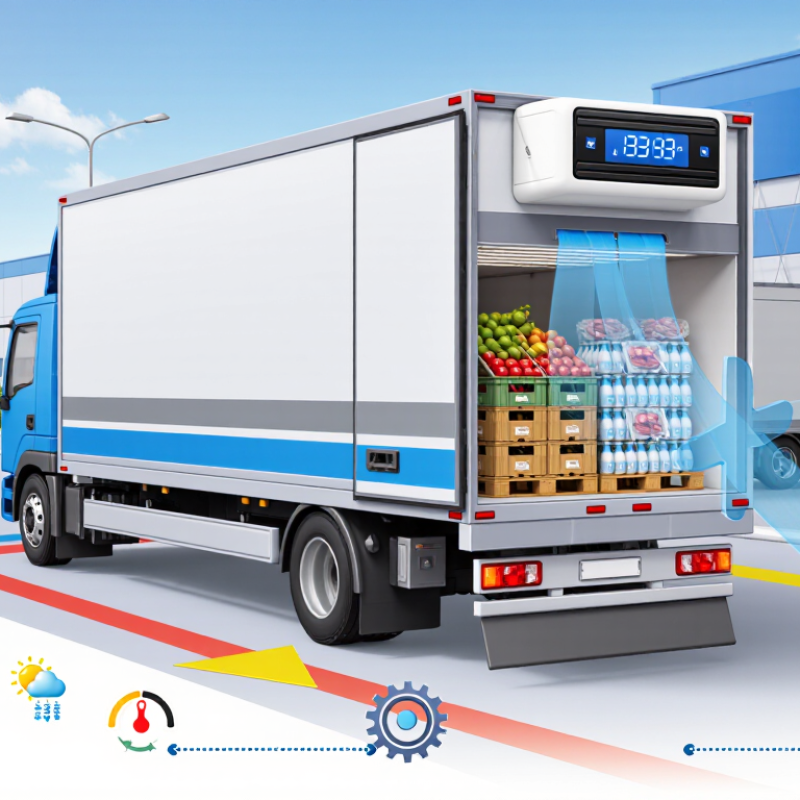
Define the cargo before comparing refrigeration units. Fresh produce, dairy, and frozen foods need different temperature ranges, airflow, and humidity control. Ask for the shipper’s written setpoint and loading instructions; “keep it cold” is not a specification. USDA estimates that 30–40% of the U.S. food supply is lost or wasted. Transport is only one part of that problem, but poor temperature control can add avoidable risk. A single setpoint cannot describe every pallet. For mixed loads, check whether the goods can safely share a compartment, or whether separate zones are needed.
Then map the route, not just the distance. Note expected stops, delivery windows, border or warehouse queues, and how often doors open. A short route with repeated loading stops may challenge temperature stability more than a longer, steady drive. Confirm the unit can maintain the target during the expected ambient conditions and dwell time. Pre-cool the cargo when its handling instructions require it; a truck unit is generally designed to maintain temperature, not rapidly cool warm product. Use calibrated data loggers at representative positions, and review product temperatures as well as the unit’s display. Small details matter. Sensor placement is easy to overlook, and one reading may not capture every corner of a loaded trailer.

Choosing a Truck Refrigeration Unit starts with the cargo’s temperature range and route, not the largest capacity number. Engine-driven vapor-compression units suit frequent loading and long routes; electric standby supports cooling while parked at a depot. Eutectic plates can work on predictable, shorter routes, but their stored cooling is finite. Multi-temperature systems add flexibility, though partitions can reduce usable space. FAO’s 2023 report estimates that 13.2% of food was lost between harvest and retail in 2021. Temperature control matters, but the right equipment depends on the actual load.
Compare rated cooling capacity in kilowatts at the conditions you expect: high summer ambient temperatures, door openings, and the cargo’s pull-down needs. A rating at mild conditions may mislead. UNECE’s ATP temperature classes provide a useful check: Class A covers 0°C to +12°C, Class B down to −10°C, and Class C down to −20°C. Match the class to the product, then check capacity against insulation, cargo mass, and route duration. The International Institute of Refrigeration’s 2023 report estimates refrigeration and air conditioning use about 20% of global electricity. Efficiency is not a footnote. I still see buyers trust one catalogue figure too much; real-world loading can undo a tidy calculation. Test with a loaded vehicle and temperature loggers.
| Refrigeration Unit Type | Typical Vehicle or Setup | Indicative Cooling Capacity | Typical Temperature Use | Best Suited For | Key Considerations |
|---|---|---|---|---|---|
| Direct-drive unit | Small van or light commercial vehicle; driven by the vehicle engine | About 1–3 kW, depending on operating conditions | Usually chilled goods; some configurations can support frozen transport | Local deliveries, smaller loads, and routes with frequent stops | Compact and generally straightforward to install. Cooling output may vary with engine speed, and the unit typically stops when the vehicle engine is off unless an auxiliary power option is fitted. |
| Self-powered truck unit | Medium or large truck with an independent engine-driven refrigeration system | About 3–12 kW; larger systems may provide more | Chilled or frozen transport, depending on the selected unit and body insulation | Longer routes, larger cargo bodies, and deliveries where cooling must continue while parked | Can operate independently of the truck engine. Consider fuel use, servicing, noise limits, and the unit’s rated capacity at the required box temperature. |
| High-capacity system | Large truck or trailer with a high-output refrigeration unit | About 8–15 kW or more, depending on the system and rating conditions | Chilled or frozen loads; capacity must be checked at the target temperature | Large cargo volumes, demanding ambient conditions, and frozen distribution | Higher output can support greater heat loads, but it does not replace adequate insulation, airflow, or correct loading practices. Confirm capacity at the intended operating temperature. |
| Multi-temperature system | Truck or trailer divided into two or more insulated compartments | Often about 5–15 kW total; output is shared across compartments | Different zones can carry chilled and frozen goods at separate setpoints | Mixed loads, such as chilled food and frozen products on the same route | Useful for mixed-temperature deliveries. Compartments, partitions, doors, and air distribution affect performance; check capacity available to each zone, not only total capacity. |
| Electric road unit with standby power | Refrigeration unit powered electrically during travel, often with a plug-in standby mode at a depot | Commonly about 2–10 kW, depending on vehicle size and system design | Chilled or frozen use, subject to the unit’s rated performance | Urban routes, reduced local exhaust emissions, and refrigerated parking when connected to suitable power | Check battery or onboard power capability, charging requirements, route length, and depot electrical supply. Standby operation generally requires an external power connection. |
| Electric standby system | Plug-in power option for a compatible refrigeration unit while the vehicle is parked | About 2–10 kW, depending on the unit and available electrical supply | Maintains the selected compartment temperature while connected | Depot parking, overnight storage, and reducing engine operation while stationary | Standby power is not a substitute for a road-operating system unless the vehicle has a separate electric drive system. Confirm voltage, connection type, and site capacity. |
| How to compare capacity: These figures are indicative ranges, not guaranteed ratings. Cooling capacity changes with ambient temperature, compartment temperature, vehicle body size and insulation, door openings, product temperature, and airflow. Compare manufacturer-rated capacity at the same ambient and box-temperature conditions, and size the system for the actual payload and route. Chilled transport commonly uses setpoints around +2°C to +8°C; frozen goods are commonly maintained at −18°C or colder where required by the product and applicable regulations. | |||||
A refrigeration unit must match the truck, not just the cargo. Check the body’s length, width, insulation, and available mounting space before comparing models. Measure carefully, including clearance around doors and vents. Small details matter. Also confirm the truck’s payload capacity and electrical system can support the unit without compromising safe operation.
Power use depends on cargo temperature, outside heat, delivery frequency, and door openings. Ask for operating requirements under conditions similar to your routes, not only ideal test results. A unit sized too small may struggle during hot, repeated stops. An oversized unit can add weight and consume more power than needed. Estimates vary. Real routes are rarely neat.
Fuel efficiency involves the whole truck. Consider added equipment weight, engine load, and how often the refrigeration system runs. Compare expected fuel use across a typical delivery day, then monitor actual consumption after installation. Keep door openings brief and inspect seals for gaps. A planning estimate is never perfect; weather and loading habits can shift results. That deserves attention.
Assess Temperature Controls, Safety, and Maintenance Needs
Choose controls that match the cargo’s required temperature range, not simply the lowest setting available. A clear digital display makes checks easier during loading and delivery. Look for adjustable setpoints, dependable temperature sensors, and alarms that alert the driver when readings drift. A data logger can reveal warm spots or repeated fluctuations that a quick glance might miss. Pre-cooling the cargo area and keeping air channels clear also help maintain even temperatures.
Check how the unit handles real delivery conditions. Frequent door openings can quickly affect the interior, especially on multi-stop routes. Ask whether the system can recover temperature efficiently and whether its alarms remain noticeable in a noisy cab. Safe access to service components matters too; cramped work areas can make routine inspections harder. I have seen people focus on cooling power and overlook simple details like door seals. That can be an expensive oversight.
Maintenance requirements should fit your schedule and available service support. Inspect condenser coils, filters, drains, belts, and door gaskets at intervals recommended by the equipment maker. Keep written records of temperature checks and repairs. They help identify recurring problems early. Consider parts availability and the time needed for routine servicing before purchase. No unit is maintenance-free. Even a well-matched system can underperform when airflow is blocked or a small seal leak goes unnoticed.
When comparing refrigeration unit trucks, look beyond the purchase price. Build a five-year cost sheet covering fuel, scheduled servicing, repairs, parts, and expected resale value. Include the truck and refrigeration unit separately; their service schedules and failure risks differ. Downtime costs more. Estimate lost delivery hours using your own routes, payloads, and customer commitments, not a generic industry average.
ATRI’s 2024 An Analysis of the Operational Costs of Trucking report puts fleetwide repair and maintenance costs at about 19 cents per mile, based on 2023 data. That figure is not specific to refrigeration units, but it shows why small recurring costs deserve attention. Ask suppliers for written service intervals, parts availability, warranty exclusions, and typical response times in the regions you serve. Ask for specifics. A low quote means little if a technician or critical part is unavailable during a hot-weather breakdown.
Compare after-sales support as carefully as equipment. Check whether phone support is available after hours, where qualified technicians operate, and how quickly common parts can be supplied. Request references from fleets with similar routes and operating hours. I would not trust a clean spreadsheet alone; actual repair invoices and missed-delivery records may tell a less tidy story. Keep those records for a season, then revise your cost assumptions.