SUMMER LIMITED EDITION VAPES NOW AVAILABLE

NFC Smart Door Lock technology is moving from specialist hardware into apartments, hotels, and connected homes. A tap from a phone or card can unlock a door in seconds. Yet convenience alone does not make a lock dependable.
Fortune Business Insights estimated the global smart lock market at USD 2.63 billion in 2023. Its report projected growth to USD 8.21 billion by 2032. These figures cover smart locks broadly, not NFC products alone. They still show why manufacturers are investing in connected access. The report is a useful market signal, but it cannot tell buyers how a particular lock performs in daily use.
Security technologist Bruce Schneier wrote, “Security is a process, not a product.” His principle applies here: NFC is one part of a larger access system. Readers should also examine encryption, backup entry, battery life, app support, installation requirements, and after-sales service. A lock that works beautifully in a showroom may behave differently on a thick metal door. That detail matters.
This guide introduces China’s top 10 NFC Smart Door Lock manufacturers. It compares product focus, technical capabilities, certifications, customization, and export experience. Company claims deserve verification; specifications do not replace independent testing. Some buyers may value app integration more than card access. Others need reliable offline entry. There is no perfect shortlist, and that is worth admitting. The right supplier depends on the door, users, and operating environment.
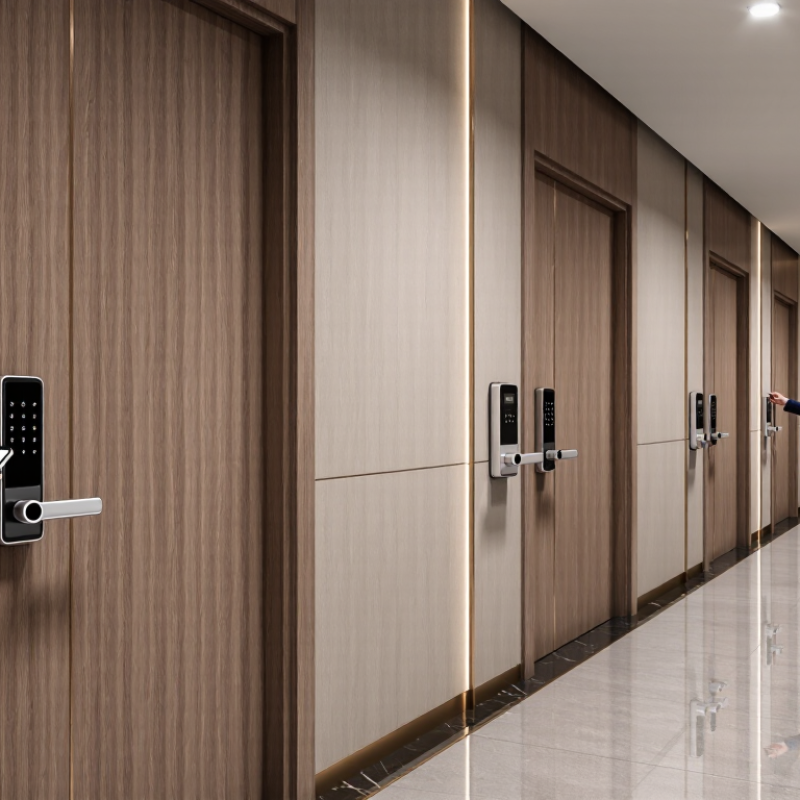
An NFC smart door lock uses near-field communication to recognize a compatible phone, card, or key fob held close to its reader. NFC works over a very short distance, often just a few centimeters. The range is tiny. That close tap helps reduce accidental reads from across a room, but it does not replace good credential security.
When a user presents a credential, the lock and device exchange data. The lock checks whether the credential is authorized, then signals its motor to retract the bolt. Depending on the design, verification may happen inside the lock or through a connected system. Some models keep access records; others offer fewer details. Buyers should check how credentials are added, removed, and recovered if a phone is lost. A confusing setup screen can matter as much as the lock’s technical features.
NFC can make everyday entry quick: tap a phone near the reader, hear a short beep, and turn the handle. Still, the experience depends on battery health, phone compatibility, and installation quality. Not magic. A poorly aligned bolt may resist even after successful authentication. Before choosing a lock, review its backup entry method and test it with the devices people will actually use. NFC is convenient, but its real value depends on reliable hardware and clear access management.

When comparing Chinese NFC smart lock manufacturers, look beyond feature lists. Ask how the lock handles failed card reads, low batteries, and interrupted network connections. Request test records for repeated tapping, latch alignment, and temperature changes. A sample installed on a real door can reveal issues that a desk demonstration misses. Small details matter.
Check how NFC credentials are enrolled, removed, and protected. Ask whether the lock supports your intended cards and phones, and verify compatibility with your access system before placing a large order. Review firmware update procedures, data handling explanations, and the manufacturer’s quality-control records. Clear answers are useful. Vague promises are not. After-sales support deserves equal attention: confirm response times, spare-part availability, and how faults are diagnosed remotely. A good factory visit helps, but it cannot replace consistent documentation. I would still leave room for doubt; even a careful evaluation cannot predict every installation problem.
Tips: Test several doors, not just one. Record read speed, error rates, and battery use during a short pilot. Keep the results, including the awkward ones.
China’s NFC smart-lock manufacturers differ in engineering depth, production scale, and export experience. Grand View Research estimated the global smart-lock market at USD 2.7 billion in 2023, with projected annual growth of 19.7% from 2024 to 2030. That forecast signals opportunity, not guaranteed demand for every factory.
Across ten manufacturer profiles, useful comparisons include NFC reader design, lock-body options, mobile-app integration, and OEM support. Some suppliers focus on compact locks for apartments, while others build access systems for hotels or offices. Look for practical details: card-reading distance, emergency power access, battery-life testing, and clear installation instructions. Small details matter.
A manufacturer’s profile should also explain compatibility limits. NFC performance can vary by phone, card type, and system configuration. Ask how the lock handles failed reads and whether firmware updates are tested before release. A polished sample may not reflect mass production. That is easy to overlook. Certifications, documented quality checks, and responsive technical support provide stronger evidence than broad claims. Comparing these points makes the ten profiles more useful to buyers than a simple ranking.
NFC communication uses standardized data rates of 106, 212, and 424 kbit/s. These are protocol rates, not measurements of a door lock’s unlocking speed or manufacturer performance.
NFC smart door lock manufacturers differ less by the tap-and-unlock feature than by how they build around it. Some focus on compact retrofit locks for existing doors, while others offer complete sets with handles, keypads, and indoor controls. A useful comparison starts with installation details: door thickness, lock-body dimensions, and whether a technician must alter the door. Small mismatches matter. A lock that fits one apartment door may not suit a glass office entrance.
Credential management is another dividing line. Entry-level models may store NFC cards locally, while connected systems can support remote permissions, activity records, and temporary access codes. Buyers should check what happens when Wi-Fi fails or a battery runs low. Is there a mechanical key or clear emergency power method? Look closely. Product ranges also vary in weather protection, reader placement, and compatibility with existing access systems. These details affect daily use more than a long feature list. Still, specifications do not tell the whole story; installation quality and after-sales support can be harder to compare. One weak point remains: published battery-life figures often depend on traffic and settings, so real-world performance may differ.
Choosing an NFC smart lock manufacturer in China requires more than comparing prices and product photos. Check how the lock handles credential enrollment, storage, and removal when a card is lost. Ask for clear documentation on encryption, firmware updates, and access logs. A supplier should explain these features in practical terms, not just list technical claims. Request a sample and test it with your own cards, doors, and access system.
Manufacturing quality matters at the hinge, reader, and battery contacts. Ask how production units are inspected and how defects are tracked. Review relevant test reports, but confirm that they apply to the exact model you plan to buy. Also discuss app or software integration, spare parts, warranty handling, and expected production timelines. One detail buyers can overlook is what happens when the network is unavailable. Test offline access before committing. A polished demonstration can still leave questions unanswered.
Tips: Send the manufacturer a written checklist and ask for specific evidence, such as sample reports or a test unit. Compare responses, not just quotations. If an answer feels vague, pause and ask again; that extra round may feel tedious, but it can reveal real gaps.
| No. | Evaluation factor | What to verify | Useful evidence or reference | Why it matters |
|---|---|---|---|---|
| 1 | NFC standards and implementation | Ask which NFC interface and credential types the lock supports, and whether compatibility has been tested with the intended cards or phones. | NFC operates at 13.56 MHz. ISO/IEC 14443 and ISO/IEC 15693 describe different contactless card technologies; support for one does not automatically mean support for the other. | Standards and credential details help prevent mismatches between the lock, access cards, and mobile devices. |
| 2 | Credential security | Request a description of credential authentication, key storage, enrollment, revocation, and protection against replay or unauthorized duplication. | Ask for a written security architecture and test documentation. ISO/IEC 14443 compatibility alone does not establish that a credential system is secure. | Security depends on the complete credential and key-management design, not just the presence of an NFC reader. |
| 3 | Mobile-device compatibility | Confirm supported phone models, operating-system versions, enrollment steps, and whether a mobile credential requires an app, cloud service, or internet connection. | Request a compatibility matrix and hands-on tests with representative devices. Phone NFC capabilities and credential access can vary by device and operating system. | A clearly defined compatibility scope reduces deployment issues and user support requests. |
| 4 | Offline operation and access management | Check whether authorized credentials work without internet access and how access changes, lost credentials, audit events, and time settings are handled. | Ask the manufacturer to demonstrate normal use during a network outage and explain any limitations on remote management or event synchronization. | Offline behavior affects availability, security procedures, and suitability for sites with unreliable connectivity. |
| 5 | Mechanical design and door fit | Confirm door thickness, backset, handing, lock-body dimensions, cylinder or latch requirements, and compatibility with the intended door material. | Use dimensioned drawings, installation instructions, and a sample installation. For relevant products, ask about testing against applicable standards such as EN 14846 or ANSI/BHMA A156.25. | A standards reference is useful only when its scope matches the product and the target market; physical fit must also be checked. |
| 6 | Environmental durability | Review the stated operating temperature, humidity limits, corrosion resistance, and suitability for indoor or exposed outdoor installation. | Request test reports that identify the tested model and conditions. Where an ingress-protection rating is claimed, check the test basis under IEC 60529 and the rating’s intended scope. | Environmental claims should match the installation conditions; a rating or test result should not be assumed to cover every exposure. |
| 7 | Battery life and emergency access | Ask how battery-life estimates were measured, including lock activity, connectivity settings, temperature, and battery type. Check low-battery alerts and emergency access options. | Request the test method and results for the relevant configuration; compare products under the same usage assumptions rather than relying on headline estimates alone. | Usage patterns and wireless features can change battery consumption, so a stated lifetime needs context. |
| 8 | System integration and software support | Clarify available interfaces, integrations, account roles, firmware-update methods, data handling, and any recurring software or cloud fees. | Request API or integration documentation where applicable, a description of update procedures, and written terms covering service availability and data retention. | Long-term operating costs and integration limits may affect the total cost of ownership. |
| 9 | Quality control and production consistency | Review incoming-part inspection, production traceability, end-of-line testing, defect handling, and change-control procedures. | Request a sample inspection plan, test checklist, and applicable quality-system documentation; verify the scope and validity of any certificates provided. | Documented controls help assess whether production units are consistently checked against the approved specifications. |
| 10 | Compliance, warranty, and after-sales support | Identify the destination-market requirements, available product documentation, warranty coverage, spare-part availability, response process, and support languages. | Request market-specific declarations or test reports where applicable, plus written warranty and service terms. Confirm that documents match the exact model and configuration. | Requirements vary by market and product configuration; clear documentation and service terms support procurement and maintenance planning. |